
One of the most challenging parts of fighting human trafficking is investigation, which leads to intervention.
It is notoriously difficult to intervene effectively and ethically in active trafficking situations.
Intervention is one of three main pillars of anti-trafficking work, the other two being prevention and aftercare. Intervention includes investigating active trafficking cases and then taking action to remove survivors and arrest traffickers. This part of combating modern-day slavery is challenging and complex — and it’s absolutely vital.
Human trafficking happens in hidden, often remote, places. It’s sometimes perpetrated by powerful organized crime syndicates. And intervention can involve going into nuanced and challenging social scenarios.
In light of all of this, human trafficking investigation can seem intimidating, too risky, or not worth pursuing for nonprofits.
At The Exodus Road, we’ve spent about 15 years honing best practices in the field of human trafficking investigation, including adapting with time to include cyber investigations. Through police partnerships and the tireless efforts of our investigators, The Exodus Road has become a trusted leader in anti-trafficking investigation and intervention globally, with cases spanning over 20 countries. We’ve seen firsthand how much of a difference investigations can make and how important those best practices are.

Here are 5 reasons human trafficking investigations are central to what we do to combat modern-day slavery.
1. The problem of human trafficking is massive, and we need accurate information to solve it
Human trafficking is a $236-billion industry that currently impacts up to 49.6 million individuals globally. There are a multitude of factors that contribute to trafficking, including poverty, war, and displacement.
Systemically changing those contributors will take a long time. In the meantime, millions of men, women, and children are suffering.
Despite its prevalence, trafficking’s hidden nature means that accurate data is incredibly difficult to obtain. Information gathered by sources such as the Human Trafficking Hotline, while valuable, can be inherently skewed. These resources often over-represent a specific kind of person: someone who can identify that they are being trafficked, with the means to contact a hotline without being caught, and the ability to find reporting mechanisms to begin with.
The vast majority of human trafficking victims don’t match this profile. They are usually the most vulnerable members of the population, often not speaking the language of the location where they’ve been trafficked, sometimes not even knowing where they are or that they are victims of a crime.
If we solely rely on self-reporting of human trafficking, we will miss a huge swath of people who need help. This is why it’s critical to have trained professionals gathering intelligence to identify victims.
2. Human trafficking investigations are a globally, governmentally recognized priority
The U.S. Department of State releases a yearly Trafficking in Persons Report that assesses the state of individual countries’ response to human trafficking. One of the key indicators they consider is the robustness of investigative frameworks in each country.
The report offers prioritized recommendations for how each country can improve its efforts to combat human trafficking.
Over the past five years, one of the U.S. State Department’s top five recommendations was to increase human trafficking investigations or improve law enforcement’s ability to convict traffickers in each of the countries where The Exodus Road works.
For example, the first recommendation for Thailand from 2025’s report is to “proactively investigate and prosecute officials allegedly complicit in facilitating trafficking, and seek adequate penalties for convicted traffickers, which should involve significant prison terms.“
That’s precisely what human trafficking investigations allow, by providing detailed and actionable evidence to law enforcement.
3. Investigations make a significant impact on stopping trafficking and preventing potential trafficking
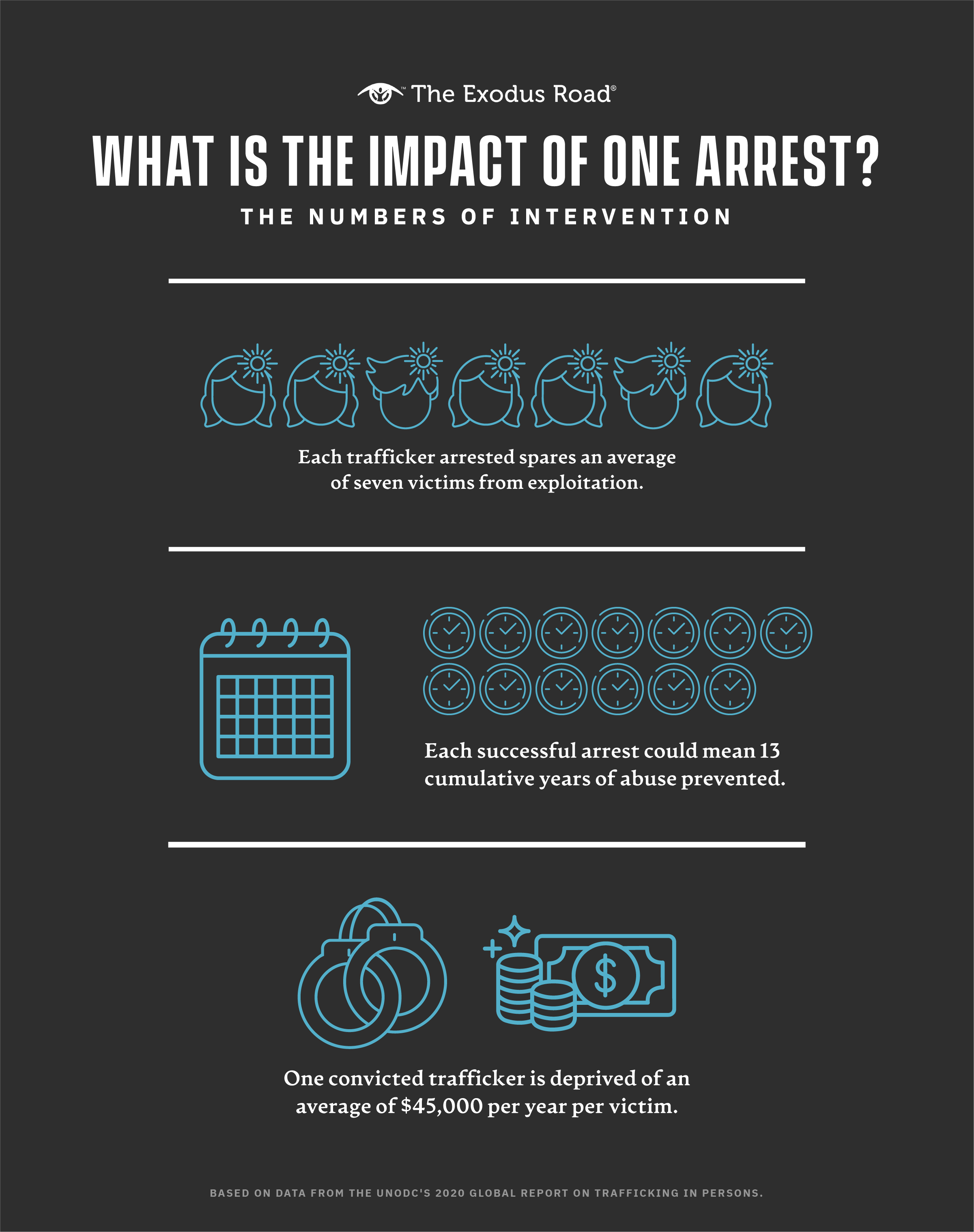
The potential for systemic impact through human trafficking intervention is huge. According to data from the UNODC, traffickers of various types exploit an average of seven victims (ranging from individual traffickers who exploit an average of 2 victims to organized criminal groups who exploit an average of 13 victims).
This means that, on average, each trafficker arrested could spare seven victims from exploitation.
According to the same report, a victim of human trafficking experiences an average of 22.5 months of abuse, though this too varies by type of trafficker. Given an average of seven victims being spared through one human trafficking arrest, that could mean 13 cumulative years of abuse prevented by human trafficking investigation.
Intervention sends the message to traffickers that this crime won’t be tolerated. In some scenarios, the tragic truth is that traffickers can exploit others with a relatively low risk of being caught.
Investigation, prosecution, and conviction make trafficking a higher risk proposition and warn traffickers of the consequences of this crime. It’s how we make trafficking dangerous for traffickers.
4. Leaving human trafficking voluntarily is rarely possible; intervention is often needed
Experts in the field agree that human trafficking raids — when law enforcement forcibly enter places such as brick factories, fishing boats, or brothels to intervene — are deeply traumatic for survivors.
So why investigate and intervene, rather than allowing survivors to leave on their own terms and caring for them then?
Intervention responds to the reality that most people being trafficked can’t leave. This is particularly true in low- and middle-income countries, where young girls and boys from rural areas are transported to large cities and forced into labor or sex work. In these scenarios, police intervention may offer the only possibility of freedom.
One of the most crucial ways to minimize the trauma an intervention can inflict on a survivor is by doing diligent investigation beforehand.
Due to the cyclical nature of exploitation, rushing into a situation without prior detailed intelligence gathering can make it difficult to discern who is being exploited and who is doing the exploiting.
Meticulous evidence gathering allows law enforcement to enter a human trafficking situation knowing exactly who they intend to arrest and who they need to free. This also allows them to bring along appropriate support for survivors, including trauma-informed social workers and advocates.
5. Human trafficking often involves networks and syndicates, and investigation stops those networks at their source
Stopping human trafficking requires changing entire communities. Investigative work is a part of pulling systems of exploitation out by the roots rather than simply picking out individual weeds. Often, an investigation yields information about traffickers’ networks. Increasingly, The Exodus Road intentionally builds cases with networks and follow-up in mind.
This means that one investigation can lead to several more. The Exodus Road’s teams have often experienced this. In Operation Grandmother, one young woman’s freedom ultimately led to an entire ring of traffickers being arrested. In Operation Decade, revisiting the site of exploitation a decade later allowed investigators to help law enforcement crush lingering trafficking activity.
Intelligence gathering can also uncover patterns of human trafficking, such as frequently used recruiting methods, points of transit, or economic risk factors that see the same community exploited repeatedly.
This depth of information improves and informs ways to address this crime. Work like this should never happen in a vacuum. Investigation is best when it informs ongoing prevention efforts. This empowers local justice and legal systems to effect long-term change.

Who should investigate human trafficking?
Even once we reach the conclusion that human trafficking investigations are necessary, some people might have concerns about whether nonprofits should be involved. What if we just left investigative work to law enforcement?
The unfortunate reality is that law enforcement units are often extremely under-resourced to combat modern-day slavery, especially in low-income countries where technology and manpower might be sparse. Even in the United States, nonprofits have become key players in the fight for freedom.
Time, personnel, and funding help combat trafficking
“For local law enforcement, one of the biggest hurdles in investigating human trafficking is having the availability of officers to handle a crime like this,” explains Theresa Nietzel, a human trafficking investigator with the Erie County, New York Sherrif’s Office. “The solution is having partners who are trained to do this. It’s important for agencies to realize that help is available and they don’t have to do it alone.”
Matt Blumenthal, a sergeant with the San Diego County Sheriff’s Department, told Thorn how tips from a variety of sources have become integral to the Sheriff Department’s work: “We receive tips and leads from various sources and vigorously investigate everything we get our hands on. We network with other law enforcement agencies, NGOs, churches, schools, military, hospitals, and many other entities.”
Even in a relatively well-resourced police force with a human trafficking team, like that of Colorado Springs, Colorado (where one of The Exodus Road’s U.S. offices is located), the time-intensive nature of human trafficking investigation greatly limits how many cases they can pursue. According to Former Metro Vice Unit Commander Scott Whittington, investigating just one illicit massage parlor takes hundreds of hours.
Nonprofits like The Exodus Road, with their highly skilled and vetted investigative teams and access to technology platforms for online investigations, have become a key part of filling in those gaps in personnel and man-hours. With many of the investigators coming from a military or police background, our teams are adept at collaborating with law enforcement.
With dedicated time and attention focused on this one issue, nonprofits can ease the burden on government officials. This allows officials to respond to more people who need help now.
Expertise and training to fight human trafficking
Another key resource that nonprofits can offer law enforcement is expertise and training. Because police training must cover a wide array of criminal industries, time dedicated to human trafficking-specific continuing education might be limited.
Non-governmental investigators usually have much more focused areas of expertise. As they spend all their time investigating trafficking, they may even learn about valuable tactics and trends that they can bring back to law enforcement.
In Brazil, The Exodus Road has combined the experience of our investigators with that of anti-trafficking experts native to the country. The result is TraffickWatch Academy Brazil, a training program that has resulted in dozens of successful investigations — such as the story of Anna.
Anna was kidnapped from her home in Paraguay and forced into sexual exploitation in Brazil. Police were able to notice red flags of trafficking because of the TraffickWatch Brazil training. Thanks to this, Anna was liberated and reunited with her family.
One other asset nonprofits can offer is community access. The UNODC explains that civilian involvement is vital for accessing individuals who might be suspicious of law enforcement. This applies to relationships built with traffickers to gather evidence.
More importantly, nonprofit involvement supports survivors. Traffickers may have threatened survivors extensively with arrest or deportation if they communicate with law enforcement. Survivors may have been arrested in the past (sometimes mistakenly, their trafficked status going unnoticed). This means that, in the course of an investigation, intervention, and the ensuing court case, nonprofits can become crucial advocates for survivors.

Expertise and ethics are key to human trafficking investigations
It’s not enough to simply identify the importance of investigating and dive in with a mindset that “the ends justify the means.” Investigations into cases of human trafficking should be carried out with the utmost attention to best practices and ethics.
At The Exodus Road, our teams are highly vetted, undergo background checks, and receive additional training, counseling, and psychological evaluations where appropriate. We have developed an investigative manual, approved by the Ethics Committee on our Board of Directors, that equips our teams to conduct high-quality intelligence gathering both online and in-person.
This includes ethical practices when interacting with potential victims. Consistent and ongoing training and accountability are crucial to the safety, effectiveness, and integrity of this work.
Another key factor of ethical investigations is continually improving the ways in which survivors are honored and resourced through investigations. The global conversation in anti-trafficking work is increasingly centered on trauma-informed approaches to ensure survivors’ agency is respected. This includes employing a social worker whose sole focus during an intervention is advocating for a survivor’s needs.
Other elements of ethical investigations include responsible collaboration with law enforcement to ensure systemic impact: upholding a strict standard of confidentiality for all case information, using intentional survivor-centric language, and empowering local communities to lead the fight.
Best practices in this field are continually improving, and we must have the flexibility and humility to continue learning and adapting.
Human trafficking intervention work matters
Given the enormity of the problem and the urgent needs of people in trafficking right now, investigating cases so that law enforcement can act remains a key part of the fight for as long as humans are still being bought and sold.
When approached with excellence and integrity, human trafficking investigations can help usher in the systemic change necessary to end this global scourge. Nonprofit intervention supports and extends the impact of law enforcement, uproots trafficking systems in whole communities, and provides an exit for people who are suffering right now with no other way out.
To learn more about the impact of human trafficking investigations, visit our index of operations that resulted in survivors being set free and traffickers being arrested.
* Images are representative