

Many countries have legislation recognizing human trafficking as a crime, though the scope and penalties of these laws vary.
For example, in Thailand, the penalties within The Anti-Trafficking in Persons Act vary depending on the accused persons’ level of involvement in trafficking persons, the age of the trafficked victims, and whether they obstructed a criminal investigation. In the United States (U.S.), all states have criminalized human trafficking, though anti-trafficking statutes vary according to how human trafficking is conceptualized, offense severity and penalties, and the inclusion of laws aimed at holding other parties accountable for their involvement in trafficking.
Anti-trafficking legislation is still relatively new. For example, in the U.S., the first comprehensive federal law to address human trafficking – The Trafficking Victims Protection Act — was passed in 2000. A collection of protocols and laws to combat human trafficking can be found from the Warnath Group.
These laws can be tools in the fight against human trafficking and in the pursuit of justice for survivors. However, even with anti-trafficking legislation in place, several major challenges persist:
- Multiple issues hinder police’s ability to identify human trafficking
- Challenges persist in prosecuting trafficking cases
- Survivors of human trafficking often do not view the criminal justice system — or criminal legal system, as survivors are unlikely to experience justice — as a safe avenue for support
This means that a shockingly low number of human trafficking cases ever reach court at all, and if they do, they don’t always reach a resolution in favor of survivors. For example, in 2021, an estimated 50 million individuals were being trafficked on any given day. But the U.S. State Department reported that in that same year, only 5,260 traffickers were convicted globally.
Why is the human trafficking conviction rate so low? What makes trafficking so difficult for police to identify in the first place? How could the system change to achieve justice more often?
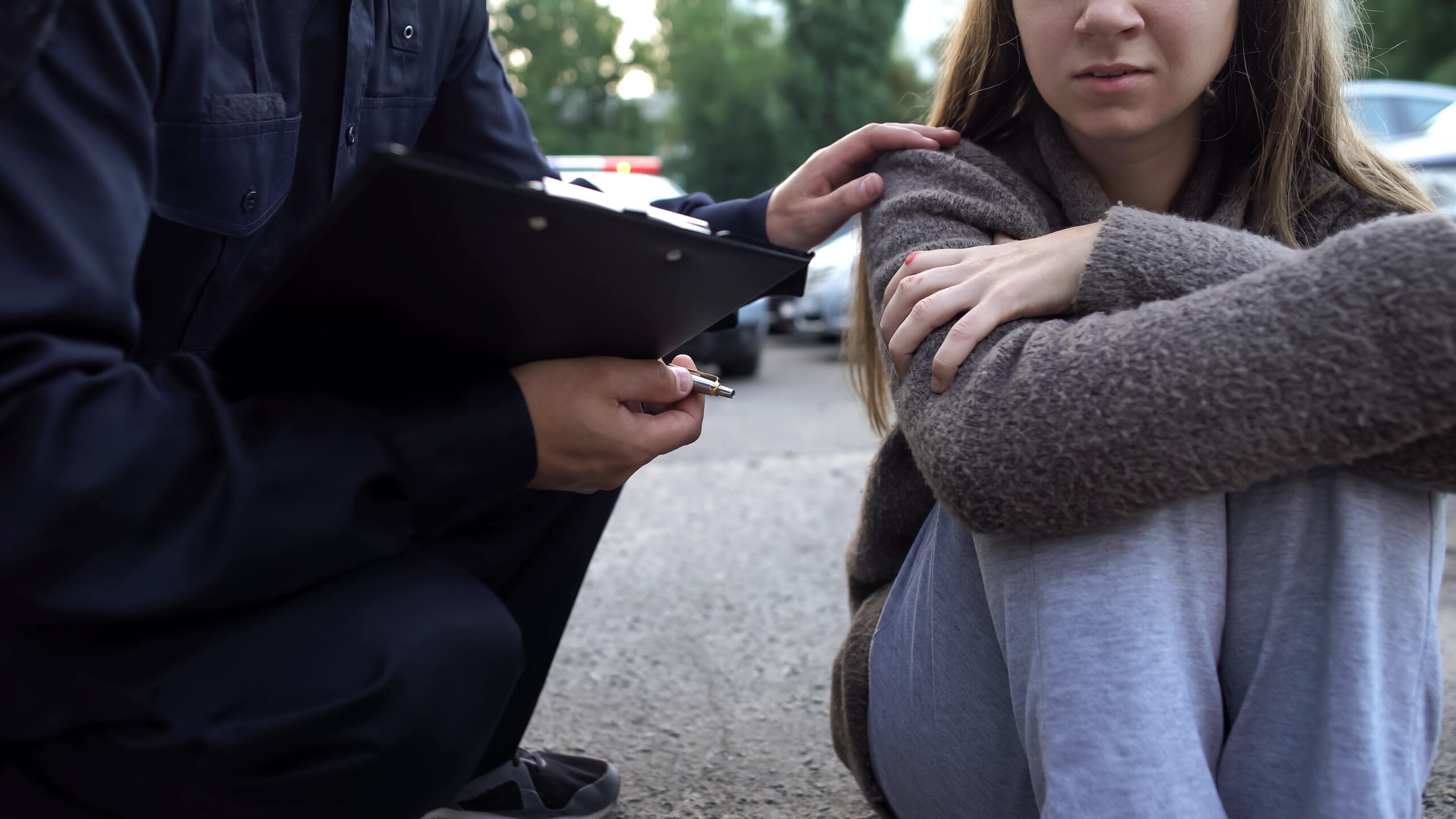
Police response to human trafficking survivors
Police are often the first point of legal contact for trafficking victims. Despite their potential to play a crucial role in assistance, several barriers prevent police officers from identifying and reporting human trafficking situations and, in turn, supporting survivors.
Officers struggle with identifying cases of human trafficking for different reasons. Those who do not specialize in human trafficking may fail to identify trafficking while investigating other co-occurring crimes, such as domestic violence or sexual assault. These officers may not be trained to screen for trafficking, and so they may overlook key indicators, miss opportunities to collect relevant evidence, and fail to question potential victims in ways that would bring trafficking to light (Farrell, Dank, et al., 2019).
For both officers within and outside of specialized human trafficking units, they may fail to identify human trafficking due to biases they hold about the crime and potential victims. Some officers may continue to harbor myths about the nature of trafficking, such as confusing human trafficking with people smuggling (Irwin, 2017), not understanding that trafficking may or may not involve moving victims across a border.
Officers may hold biases about the people who are at risk for human trafficking that impair their identification of actual exploitation. For instance, in one U.S. study, 91% of law enforcement interviewees expressed concerns that some sex trafficking victims were being misclassified as “prostitutes” or, given that prostitution is largely illegal in the U.S., as “prostitution offenders” (Farrell, Dank, et al., 2019). In these cases, officers may find it challenging to determine whether individuals involved in sex work are perpetrators of a crime or victims of human trafficking.
This challenge may be heightened when victims do not fit common stereotypes of trafficking victims — for example, in the U.S. context, those who are adults, “do not express gratitude about being ‘rescued’ by the police or are not young, White, and U.S. citizens” (p.659) or have drug addictions may not be readily identified as victims (Farrell, Dank, et al., 2019).
Police may also fail to identify victims of other forms of trafficking, such as those trafficked for criminal exploitation or labor, due to uncertainty, biases, and the frequent victim-offender overlap. These factors also contribute to the broader failure of the criminal justice system to recognize exploitation.

Why prosecutions and convictions are rare in human trafficking cases
Several issues impact the prosecution of human trafficking cases and, relatedly, the incredibly low conviction rates for trafficking.
The false victim-offender binary
The criminal justice system relies heavily on a clear differentiation between the completely innocent victim and the completely guilty offender. However, survivors of human trafficking may be forced to engage in criminal activities during their exploitation, and in some cases may be trafficked for the purposes of criminal exploitation (see article on forced criminality).
As such, the need to categorize individuals as either victims or offenders can significantly shape how the criminal justice system responds to human trafficking victims, with limited tolerance for the victim-offender — albeit, forced offender — overlap that characterizes many trafficking survivors’ experiences.
Poor treatment of survivors by legal professionals
Trafficked individuals often face significant barriers and harm from law enforcement and within the criminal justice system that contribute to their avoidance of legal help and undermine the justice process.
For instance, sex trafficking survivors in countries where prostitution is illegal frequently avoid police due to the risk of arrest, as trafficking is commonly conflated with prostitution. Labor trafficking victims often experience disrespect and suspicion from police despite clear evidence of exploitation, which alienates victims, impedes investigations, and sometimes worsens the financial instability that contributed to their vulnerability to exploitation.
Victims trafficked for forced criminality are typically treated as offenders rather than victims throughout the “justice” process, as legal professionals often lack awareness and clear identification criteria, and prosecutors frequently view their offenses as serious crimes disconnected from their exploitation.
Across all types, trafficking survivors are often seen more as sources of evidence than victims and survivors, which contributes to retraumatization and a lack of survivor-centered justice.

Lack of evidence and/or understanding of trafficking dynamics
A major obstacle to the prosecution and conviction of human trafficking cases is the lack of sufficient evidence or the absence of an identified accused person. This sometimes occurs when survivors are too fearful to identify their trafficker due to the threats and psychological manipulation they’ve experienced.
The burden of proof is particularly high in trafficking cases, often requiring clear demonstration that coercion, fraud, or force occurred — elements that are rarely straightforward to prove. In many situations, the dynamics of trafficking are complex and misunderstood.
For instance, in labor trafficking cases, traffickers may use fraudulent contracts and weaponize complicated legal structures in immigration, family, and contract law to conceal exploitation and make coercion difficult to detect. Legal professionals — and at times survivors themselves — may struggle to distinguish between consensual and coerced acts. This can be especially true in trafficking situations that involved a grooming process, such as trafficking within the context of domestic violence, where victims may believe they had agency despite experiencing manipulation and control.
These different challenges contribute to low prosecution rates and further complicate efforts to hold traffickers accountable.

Survivor distrust in police and the criminal legal system
Survivors of human trafficking may lack trust in police and the broader criminal legal system as a means of escaping trafficking or accessing protection, support, or justice afterwards. In one U.S. study, less than 3% of 613 human trafficking incidents investigated by the police came to the attention of law enforcement through survivor self-reporting, signifying the reluctance of victims to seek help from the police.
Even after escaping a trafficking situation, survivors may not have the desire or capacity to engage with the criminal justice system. Such reluctance is to be expected considering that survivors of various forms of trafficking often have negative experiences with police or within the criminal legal system. Testifying can also be immensely retraumatizing and costly.
As another example, some police officers prioritize a misguided model of “recovering victims” — even if that means arresting them to remove them from trafficking situations — while overlooking the long-term needs that reduce their vulnerability to future exploitation. Such actions can perpetuate the very risk factors that made individuals vulnerable to trafficking in the first place. In this case, being arrested can further destabilize survivors by limiting access to education and living-wage employment due to a criminal record.
Given that many human trafficking survivors are hesitant to receive assistance from or engage with the police, identifying and building cases of trafficking can be incredibly challenging. As long as engagement with police and the criminal justice system continues to cause harm and retraumatize survivors of human trafficking, their willingness and ability to seek legal help or participate in criminal investigations will remain compromised.

Recommendations for strengthening police and legal responses
- Police training: given that human trafficking survivors are often unable to safely report their victimization, police must take a proactive role in identifying potential cases. Officers should receive comprehensive training to recognize indicators of trafficking, understand its complex realities to dispel common myths, and become familiar with relevant legislation and referral procedures to human trafficking units.
The Exodus Road provides such training for police and anti-trafficking professionals. You can start your educational journey with a basic free trafficking awareness course provided by The Exodus Road. For more specialized and in-depth training for law enforcement, contact training@theexodusroad.com. - Partnerships: police officers and other legal professionals can more effectively identify and respond to trafficking by partnering with anti-trafficking organizations and professionals who are well-versed in the power dynamics of trafficking and the complex needs of survivors. You can explore success stories of how The Exodus Road collaborated with police to free survivors and arrest traffickers.
- Evidence-informed legal reform: legislation and government funding should be guided by research on what effectively increases access to justice. For example, a U.S. study using data from 2003 to 2012 found that harsher criminal penalties were associated with more arrests and prosecution of human trafficking offenders. Greater prosecution was also higher in states that provided funding for survivor services, police training, and multidisciplinary task forces. Additionally, requiring a lower burden of proof in minor sex trafficking cases and restitution to survivors significantly increased prosecution rates.
Many of these findings align with recommendations made by survivors, who have also called for adopting more compassionate approaches, ending the criminalization of survivors, and increasing diversity within police forces.
Alternative pathways to justice: some human trafficking survivors may prefer justice approaches outside the traditional criminal legal system — such as procedural, restorative, or transitional justice — that better reflect their needs and priorities. See the following brief for survivor perspectives on these alternative models.


