

Massage parlors are one of the most common venues for sex trafficking. When that happens, they are known as illicit massage businesses (IMBs). It is particularly easy for sex trafficking to take place in these businesses because they already operate with private rooms, a lot of physical access betwen the customer and the service provider, and easily dodged legislation. Often, these businesses involve money laundering to appear legitimate.
How does sex trafficking happen in massage parlors, and what can we do about it?
Sex trafficking cases in massage parlors
These are just a few 2026 cases of sex trafficking in massage parlors in the U.S.:
- Seven people were arrested in Alaska on charges of sex trafficking linked to multiple massage parlors
- 122 people arrested and 84 charged in relation to human trafficking occurring within four Ohio massage parlors involving 42 victims
- Possible human trafficking victims found in North Texas massage parlors
The Exodus Road is no stranger to this criminal reality. The Exodus Road’s investigative team has collaborated with law enforcement to help free individuals from human trafficking from illicit massage parlors around the world. Just a few cases where we have assisted in investigating illegal massage businesses:

How do illegal massage parlors present a front as a legitimate business?
Illicit massage businesses (IMBs) are establishments that pose as legitimate massage businesses in order to facilitate commercial sex operations. In the U.S. context, these businesses operate in every state in the country, with estimates of actively operating IMBs starting at 9000.
These businesses operate in plain sight and claim to provide massages, spas, reflexology, foot massage, and bodywork. Many businesses of this type do provide those services, but often as a gateway into selling illegal sexual services.
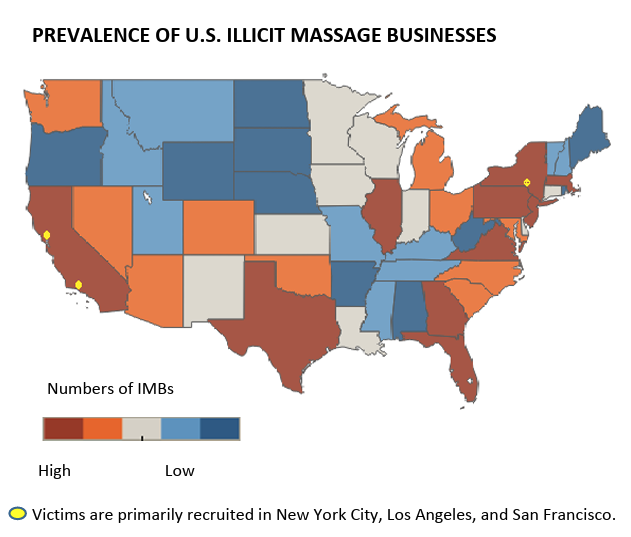
While not all IMBs are settings of human trafficking (some individuals there may be voluntary sex workers), many of them are trafficking fronts. According to a 2019 report, IMBs were the second-most common identified type of sex trafficking in the U.S.. More recently, scholarly research and data from the National Human Trafficking Hotline indicated that, among the venues for sex trafficking that we know about, IMBs were the most common.
Most of illegal massage parlors are not individual standalone businesses. They are often part of larger organized criminal networks that involve multiple illicit massage parlors across numerous locations. Polaris has suggested that the larger the network, the greater the likelihood that an IMB in that network is engaged in human trafficking.
Who is being sex trafficked at massage parlors?
Here are some factors that mark the majority of victims trafficked through illicit massage businesses in the U.S.:
1. People who recently arrived from primarily China, South Korea, Taiwan, Thailand, Vietnam, and sometimes Mexico and Central America.
These workers obtain valid visitor visas to travel to the U.S., hopeful about their pre-arranged jobs without knowing that it will be in an IMB. They usually begin work upon arrival, forced to perform sexual services while much of their earnings are withheld and their documentation is taken.
Women who are native to the U.S. may also be recruited into trafficking in massage parlors through false job ads, social media platforms, and word-of-mouth.
2. People who are in serious debt via property loans, business debt, travel debt accumulated to travel to the U.S. for work, etc., or are under other extreme financial pressure, often to support family members with medical expenses, childcare, etc.
Traffickers often add to workers’ debts through debt bondage, imposing new debts that workers are expected to repay such as falsifying the amount of travel debt to increase the financial pressure to provide sexual services for greater pay and remain in the massage businesses
3. Those who speak little or no English and have minimal education. These factors limit employment options and often coexist with other risk factors, such as limited employment experience and an inadequate social network.
4. Mothers between 30-50 years old who live with any of the above risk factors or additional challenges.
Illegal massage parlor recruiters, bosses, and managers often share the same ethnic background as the individuals they traffick. They manipulate potential victims by exploiting their vulnerabilities and cultural values.
These traffickers exploit economic pressures by offering housing, food, travel, and the promise of a substantial salary, with no required language, residency, or professional qualifications. Upon arrival at the massage parlor, managers who share the same cultural background as the worker may manipulatively attempt to form an emotional bond with the new worker through speaking about their shared experiences of struggle — for example, as Chinese women navigating migration.
Considering that most of these workers migrate to the U.S. alone and with little to no support in the new environment, this grooming-style bonding can be powerful, making workers feel welcome as the manager serves as both their host and seeming caretaker.
Once an individual starts working at the massage business, they are manipulated into providing sexual services when managers make it clear that they will not make money if they solely provide massage.
Illicit massage business bosses and managers may also exploit cultural norms. For example, the following Chinese cultural norms may be exploited:
- rénqíng or indebtedness: “favors” that IMB traffickers provided must be returned and debt repaid. Traffickers manipulate victims by claiming they are ungrateful.
- guanxi or social harmony: not wanting to disrupt the harmony of the group or being pressured to maintain a positive reputation for the business.
- miànzi or saving face: not repaying debts can be seen as dishonorable.
More explicit forms of coercion may also be used, such as threatening workers with deportation or threatening that they will shame the worker by telling their family back home that they are “prostitutes.” Traffickers may steal workers’ identification documents to prevent them from leaving.
Even the traffickers don’t take their documents, many workers have nowhere else to go, given their isolation, migration status, lack of communicative abilities, and desire not to disappoint family members by bringing them shame or being unable to financially support them.
Why is it hard to fight human trafficking in massage parlors?
Despite increased awareness of these businesses as sites of human trafficking, they continue to exist for a variety of reasons. For one, legislative requirements and corporate secrecy enable traffickers to register IMBs as legitimate businesses, with the added reassurance that, depending on the jurisdiction, the names of business owners are either not required for registration or protected by U.S. law. As one Polaris report put it, “the laws governing business registration are almost tailor-made for massage parlor traffickers to hide behind.”
Even when legislation is implemented to discourage human trafficking within these massage parlors, those operating these businesses find unique ways to continue their illicit trade. For instance, in states with licensing requirements, businesses will regularly display valid massage therapist licenses that have either been acquired fraudulently or belong to professionals that are not on-site.
The increased awareness of these businesses has had both positive and negative impacts on the police response in cases of suspected human trafficking.
Police officers in one research study reported that the growing media attention to human trafficking has resulted in increased reports to the police about IMBs and increased community pressure for law enforcement to respond. This pressure often drives a rapid police response to these businesses, including reactive investigations, sting operations, and the shutdown of massage businesses. Interviews with police, prosecutors, and other practitioners indicated these reactive responses may have limited effectiveness.
For instance, shutting down one illegal massage parlor does not guarantee that its illicit operations will cease. Because they are often part of larger networks involving multiple businesses, it can be difficult to completely shut down these operations.
Police officers have shared that the public pressure for reactive responses can complicate their efforts to develop cases in ways that would better support systemic human trafficking prosecutions and disrupt criminal networks.
Trafficking in massage parlors is a global issue
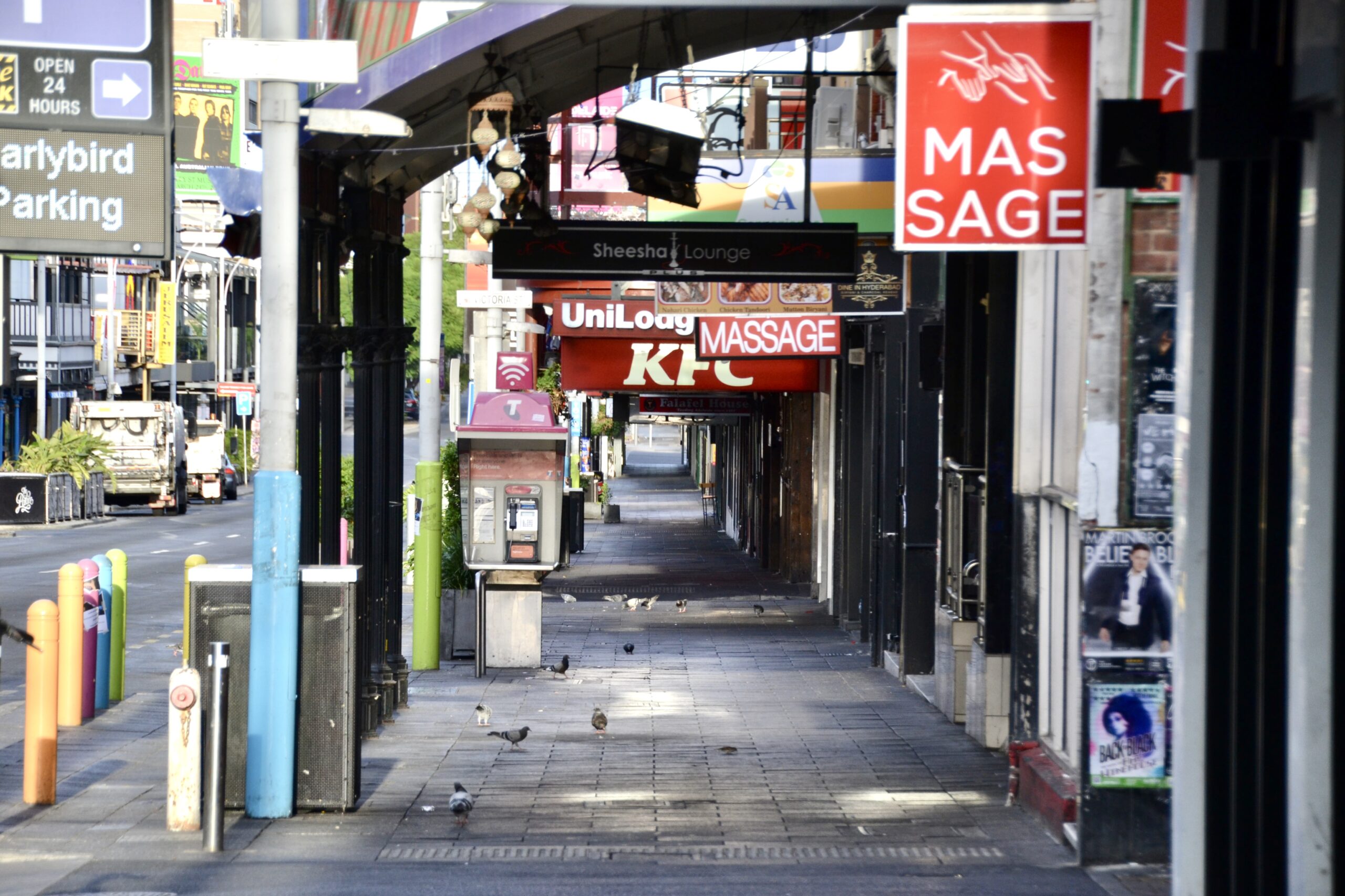
The stories of victims lured into illegal massage businesses in other countries are similar to those in the U.S. People have their preexisting vulnerabilities exploited by recruiters: being promised a legitimate, stable job with a desirable salary, only to be coerced into providing sexual services to customers.
Many of the psychological mechanisms, such as manipulation and deception, and coercive tactics, like confiscating identification documentation to force workers who have traveled for the “job” into an undocumented status that leaves them more vulnerable, are used in the same way.
The ethnic groups that are targeted by these massage parlors may vary by country, usually impacting those who are most vulnerable in those countries already. For example, traffickers in Thailand often recruit foreign nationals from neighboring countries such as Myanmar, Laos, and Cambodia.
What can we do about trafficking in massage parlors?
1. Learn the warning signs.
A massage parlors might be hiding human trafficking if it:
- Has windows that are covered or obscured
- Is open past business hours
Holds mattresses on the ground - Lists sexual services on their website
It is important to become aware of these potential indicators of human trafficking through massage parlors without stigmatizing the many legitimate massage businesses and recognizing that many parlors are not sites of human trafficking.
In the U.S., you can use the Simply Report app or website if you suspect a venue may be hiding human trafficking.
2. Support survivors in a culturally-sensitive manner.
Whether you are a helping professional, law enforcement, or someone whose is in contact with an individual being trafficked through a massage parlor, ensure that you are supporting survivors in a culturally-sensitive manner.
Many victims of this type of trafficking come from cultures in which both massage work and sex work are heavily stigmatized and sometimes falsely conflated. Shame is used to silence these victims. Obligations to financially support their families, stemming from their collectivist backgrounds, further pressure them to endure these exploitative situations.
Those of us supporting these survivors must acknowledge their complex realities empathetically and compassionately.
3. Support organizations that fight human trafficking, such as The Exodus Road.
The Exodus Road has collaborated with law enforcement in several countries to free victims of human trafficking from illegal massage parlors. The Exodus Road has supported such operations by gathering evidence for law enforcement to intervene when human trafficking is suspected, providing social worker support during and after the businesses are raided, supporting survivors’ testimonies in court, educating communities and law enforcement, and providing aftercare to survivors.
All imagery in this article is representative.


