
False Job Offers and Human Trafficking
A recent online U.S. survey found that 95% of job seekers encountered a suspicious job offer. While fake job advertisements can be created for a variety of reasons, fake job offers are often intended to scam individuals or recruit them into human trafficking. In 2025, false job promises were the top recruitment method used by human trafficking perpetrators arrested with the support of The Exodus Road.

The path between false job offers and human trafficking can take many forms. Fraudulent job offers for masseuse positions, which target both recent migrants and international applicants desperate for work, can quickly turn into sex trafficking. A seemingly promising and lucrative (but fake) I.T. job opportunity in Southeast Asia can lead to human trafficking for the purpose of forced criminality. A seemingly legitimate agricultural position abroad can be used to recruit a worker into labor trafficking.
Recruiters use a variety of methods to lure victims through fraudulent job offers, often exploiting potential victims’ vulnerabilities such as poverty, financial desperation, precarious migration status, and lack of alternate opportunities.
Kinds of false job offers
Local false job offers
In a local context, false job offers may be used by recruiters who have influence or power to deceive or coerce potential victims or who exploit potential targets’ vulnerabilities by offering support in the form of a false job opportunity.
In a study (cited in Querol & Lerner, 2024, page 110) on minor victims of human trafficking in Peru who were between 11 and 17 years old when they were recruited, exploited, and recovered, “an uncle, neighbor or stranger offered them a false job offer, tricked them through seduction, or used sponsorship or patronage as a strategy.”
Once trapped, these youth were either transferred outside of their region, displaced within the region, or remained within their family homes, “since the extortion and threats were strong and effective enough to exploit them even while living with their families.”
International false job offers
International human trafficking networks use false job offers to recruit victims. In a study with 430 victims of sex trafficking in Turkey, 72% of victims were recruited from their homeland, representing 14 different nationalities. Among these victims, 73% were recruited through a false job promise. In some cases, victims had responded to a job ad that they found themselves, as described by the following Russian trafficking survivor:
“One day, I was reading a newspaper. I saw a small ad offering good jobs in Turkey. I called the number and made an appointment. I went to the address that was given in the phone call. I went into the office. The lady in the office told me there was a dancer position in Istanbul, Turkey, and I would make $3000 per month. She also offered to cover my passport and travel expenses to Turkey. I accepted her offer.”
In other cases, female recruiters convinced victims or their families of false job opportunities:
“My childhood friend from Kyrgyzstan told me that there were good job opportunities for translators in Turkey, and if I would go with her, we would make tons of money together. It was an attractive offer for me, because I knew different languages at the translator level. She completed all my passport and ticket procedures for me. I did not talk about my plans for Turkey to my family. Then, we departed from my homeland together.”
When attempting to recruit victims internationally, traffickers often promise support with travel costs and required documentation, making the fraudulent job offer even more appealing to job-seekers experiencing financial insecurity with minimal to no other options. Upon arrival at the location, victims soon learn that the job they were promised does not exist and are forced into sex trafficking (or other forms of trafficking) through exploitation methods including debt bondage, violence, threats (of deportation, shaming, and police reporting), confiscation of travel documents, and confinement.

Online false job offers and A.I.
Online recruitment methods are becoming increasingly common, particularly through social media. Moyo and colleagues described two primary methods through which victims are recruited via false job advertisements on social media platforms.
Posting fraudulent job advertisements to target jobseekers who may provide contact information
Traffickers will follow up with interested applicants. Alarmingly, easily accessible A.I. tools are increasing the threat of trafficking through false job advertisements. Some of the red flags that would usually caution job seekers from pursuing a seemingly illegitimate job opportunity, such as lack of professional language in the job advertisement, can now be fixed using A.I. tools that mimic authoritative styles and incorporate professional jargon. This creates polished fraudulent job postings that appear authentic.
Actively monitoring social media sites for potential victims
Sometimes, traffickers monitor content posted by those who have responded to their fraudulent job ads to assess their job interests and level of desperation. Again, A.I. is being used by traffickers to enhance their ability to use this strategy to recruit victims.
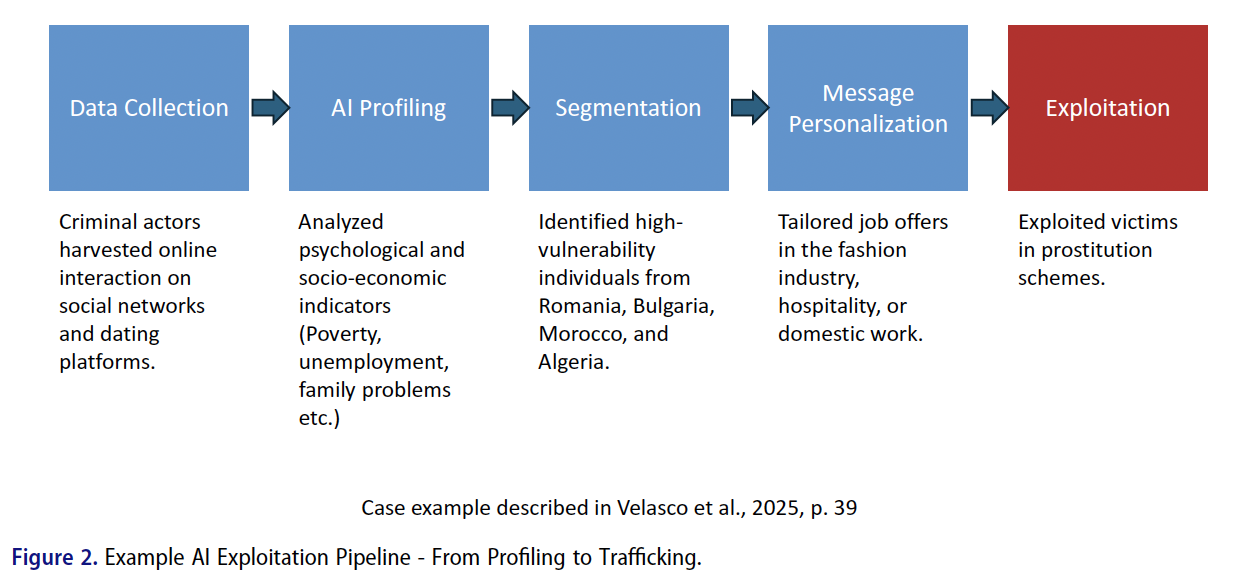
A 2025 report from El PACCTO described a 2022 joint Europol, French, and Spanish police case wherein a sophisticated human trafficking network used A.I. to identify, target, and recruit vulnerable women:
“The AI algorithms used by this criminal network analyzed the psychological and socio-economic profiles of potential victims, segmenting young women in vulnerable situations, such as poverty, unemployment or family problems. The AI systems were able to filter these data from the victims’ on-line interactions, social media comments and search activity. Using this information, the criminals personalised messages and offered false job opportunities in Western Europe, such as jobs in the fashion industry, hospitality or domestic work. Once trust was established, the victims were convinced to travel to countries such as Spain and France, where, upon arrival, their documents were confiscated and they were forced to work in prostitution networks.”
Based on this case, Levesque created a visual representation of how AI tools can be used to guide all stages of the pathway from fraudulent job offers to human trafficking:
Warning signs of fake job offers
Several key indicators suggest a job offer is fraudulent. Moyo and colleagues investigated frauds on social media platforms and described the following common signs that a job offer is fake:
| Theme | Indicators |
|---|---|
| Attract Wide Audiences |
|
| Use of Informal Writing |
|
| Offer Attractive Packages |
|
| Use of Known Trafficking Details |
|
| Request for Personal Information |
|
Based on expert data provided by job sites and international organizations, here is our list of warning signs that a job offer may be fake and even be recruiting individuals into human trafficking:
01You did not apply for the job
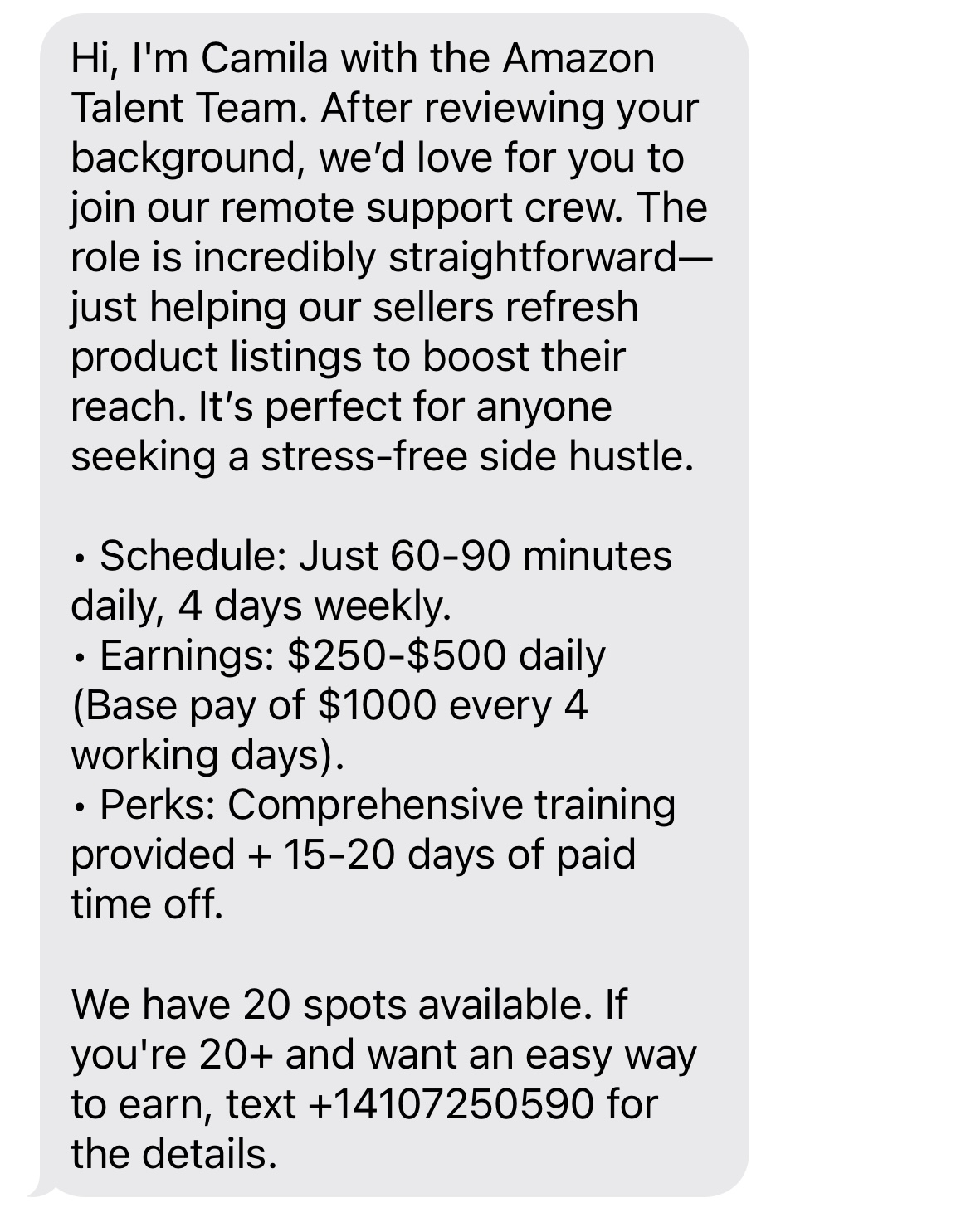
If you receive an offer for a job without applying or having previously initiated contact with the company, this is a major red flag. In these cases, scammers may reach out through call, text, or email posing as recruiters from familiar companies (i.e., Amazon) or job sites (i.e., Indeed) to offer a job you did not apply to.
02Too good to be true
False job offers often promise an unusually high salary for minimal hours of work. For example, in the text offer below, the job offers a minimum of $1,000 for working only 60-90 minutes per day, for four days. This indicates another red flag: a schedule that is too flexible (again, for an unusually high pay). These are both indicators that this offer is “too good to be true” and likely fraudulent.
03Vague company details
A common red flag of a false job offer is vague or unverifiable company information. If a recruiter cannot provide basic details, such as a company website with staff members, registration number, physical address, or other information that confirms the organization is legitimate, the job offer may be fraudulent. Notably, there is growing recognition that AI is being used to enhance the believability of false job offers. Accordingly, recruiters can use AI tools to create a fake website or social media profiles for fake staff. Continue to look for other red flags outlined here, even if the job offer looks realistic.
04Vague and unprofessional job description
Fraudulent postings often provide few details about the role and list only broad, minimal qualifications that almost anyone could meet rather than specific skills or experience. Also, look out for unprofessional language or glaring spelling and grammar mistakes.
05Urgency and pressure
Once the job is offered, you may be pressured to make a quick acceptance decision, discouraged from asking questions, or to keep the opportunity secret. These tactics are often used to limit individuals from verifying the opportunity or seeking advice from others.
06Free visa and travel
Jobs that require travel to another country should provide clear information about the legal authorization required to work there and, where appropriate, support you in obtaining the correct work visa (not a tourist visa) through official government processes.
Be cautious if an employer encourages you to enter on a tourist visa, tells you that a work visa is unnecessary, or does not discuss work authorization at all. These can be red flags signaling a trafficking tactic to leave you without legal work authorization and make you more vulnerable to exploitation.
07Attractive locations
There are well-documented stories about individuals who were offered exciting jobs that promised a new life in Trinidad and Tobago, Thailand, and Spain, flown out, and then forced into sex trafficking, labor trafficking, or forced criminality within scamming compounds soon after their arrival. In other cases, false job offers are made within the victims’ country of residence, exploiting their vulnerabilities to recruit them into different forms of trafficking.
08The company requires payment or personal information
If you receive an offer that requests payment instead of an interview, processing fees for the offer, or asks for personal information upfront such as your social security number or bank information, this is very likely a false job offer. Traffickers are testing your willingness to share sensitive information and susceptibility to exploitation — financial and otherwise.
What can you do about false job offers?
It’s up to all of us to keep our eyes open and learn what to do about the false job offers that lead to trafficking.
- If you see a suspicious job offer, report it on whatever platform you spot it.
- If someone you know is planning to work abroad, review their job offer and examine it for the warning signs we shared in this article.
- If you visit an establishment and suspect someone is a victim of human trafficking, you can report it to local law enforcement if someone is in immediate danger or an organization that fights human trafficking in your country or the national hotline in your country.
- United States: Use the SimplyReport app, chat, or call 833-523-7233.
- Canada: Canadian Centre to End Human Trafficking at 1-833-900-1010.
- Donate to organizations that provide aftercare to survivors of human trafficking, such as The Exodus Road. Comprehensive aftercare enables survivors of human trafficking to overcome the conditions that made them vulnerable, such as financial insecurity, lack of job opportunities and training, or lack of social support. Read Aree’s experience of how Freedom Home — a safe house in Thailand operated by The Exodus Road — gave her “a new lease on life, a brighter future” after escaping a trafficking situation that began with a false job offer.
- Spread awareness by sharing articles like this one on social media and with your family and friends.